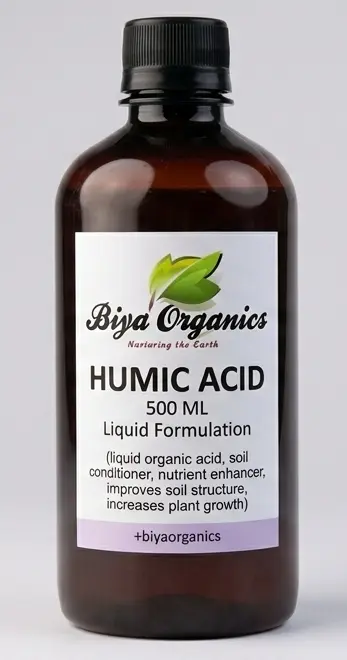
Humic Acid
Humic acid products contain humic substances derived from organic matter sources such as leonardite, compost, or humate deposits. They are best understood as soil conditioners and nutrient-efficiency helpers, not complete fertilizers.
Product Overview
• Product Name: Humic Acid
• Category: Nutrients and Plant Supplements
• Product Type: Humic substance soil conditioner and biostimulant
• Form / Texture: Liquid concentrate, soluble powder, or granules depending on product
• Suitable For: Soils with low organic matter, container plants, lawns, orchards, and nutrient-efficiency programs
• Application: Soil drench, fertigation, foliar spray where labeled, or granular soil application
Why Humic Acid Is Useful
• Can improve nutrient availability and root-zone chemistry.
• Supports soil organic matter functions.
• Often used with fertilizers to improve efficiency.
• Useful in low-organic-matter or stressed growing conditions.
Main Components
• Humic acid and related humic substances.
• Fulvic acid in some products.
• Potassium humate or other salts depending on formulation.
• Carrier water or granule base.
Benefits
• Helps nutrients remain more available in the root zone.
• May support root growth and microbial activity.
• Can improve soil structure over repeated applications.
• Useful with micronutrient programs.
Growing and Application Requirements
• Use with a real nutrient program; humic acid is not complete plant food.
• Follow label rate because concentration varies widely.
• Apply to moist soil for best movement into the root zone.
• Check compatibility before tank mixing. Usage Instructions
• Dilute liquid products as directed.
• Drench around roots or apply through irrigation where allowed.
• Use during active growth or after transplanting.
• Repeat at label interval rather than overapplying.
Common Uses
• Soil conditioning • Root support • Fertilizer efficiency • Micronutrient availability • Stress recovery
Advantages
• Useful with many crops and ornamentals.
• Works well in soil-building programs.
• Can complement organic and synthetic fertilizers.
Disadvantages or Limitations
• Not a substitute for NPK or micronutrients.
• Product quality varies.
• Benefits may be subtle in already healthy soils.
Maintenance and Storage Tips
• Apply after watering or before light irrigation.
• Use lower rates in small pots.
• Store liquid products away from heat.
Safety and Precautions
• Avoid inhaling powders.
• Wear gloves because concentrates can stain.
• Keep container tightly closed.
Best Plants or Situations
• Lawns • Vegetables • Fruit trees • Potted plants • Low-organic-matter soils
Useful Facts
• Humic substances are part of natural soil organic matter.
• They influence nutrient holding and root-zone chemistry more than they directly feed like fertilizer salts.
Summary
Humic acid is a soil-support product that helps the plant environment work better. It is most useful when paired with compost, sensible fertilization, and healthy watering.
References Consulted
• HortScience - Humic and fulvic substances in horticulture: https://journals.ashs.org/downloadpdf/view/journals/hortsci/59/2/article-p235.pdf
• University of Minnesota Extension - Soil biology: https://extension.umn.edu/soil-management-and-health/soil-biology
• University of Maryland Extension - Garden fertilizer basics: https://extension.umd.edu/resource/garden-fertilizer-basics/