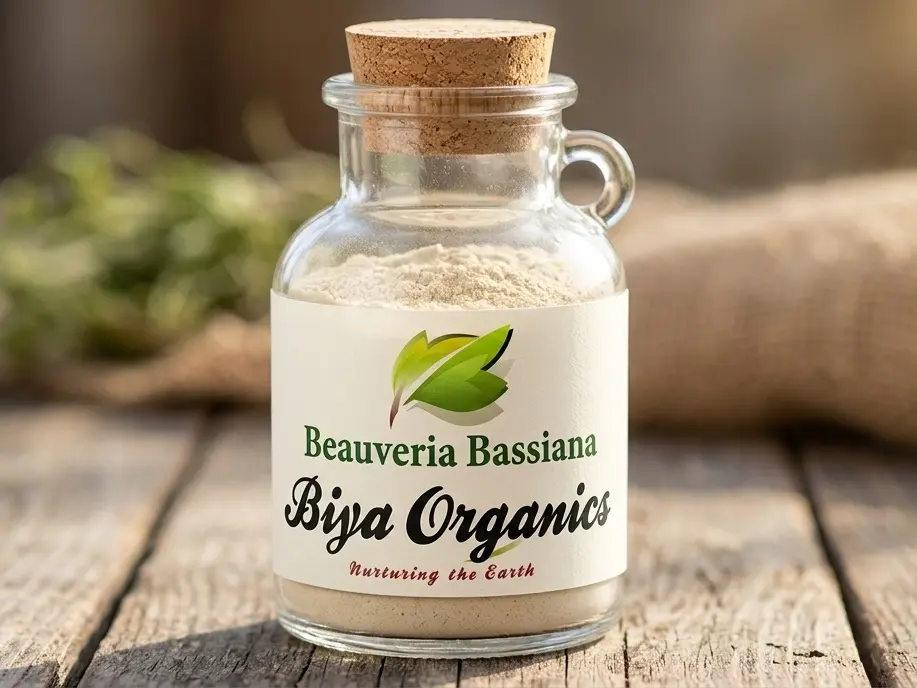
Beauveria Bassiana - Bottle
Beauveria Bassiana
Beauveria bassiana is a naturally occurring fungus used as a microbial insecticide. It infects susceptible insects on contact, so coverage, humidity, timing, and label directions matter more than simply applying a heavy dose.
Product Overview
• Product Name: Beauveria Bassiana
• Category: Pest Control and Plant Protection
• Product Type: Entomopathogenic fungal biopesticide
• Form / Texture: Wettable powder, suspension, granules, or oil-based formulation
• Suitable For: Whiteflies, aphids, thrips, mealybugs, mites, and other pests where the label allows
• Application: Foliar spray or targeted pest-contact application
Why Beauveria Bassiana Is Useful
• Biological option for integrated pest management.
• Targets insects through fungal infection rather than synthetic chemical poisoning.
• Useful where repeated broad-spectrum insecticide use is undesirable.
• Can fit organic-style pest programs if the specific product is allowed.
Main Components
• Live spores of Beauveria bassiana strain.
• Carrier material and wetting agents depending on formulation.
• Sometimes oil or emulsifier to improve contact.
Benefits
• Helps manage soft-bodied pests when coverage is good.
• Can reduce chemical pesticide dependence.
• Generally works well in IPM programs with monitoring.
• Useful for greenhouse, nursery, and field situations where registered.
Growing and Application Requirements
• Must contact the pest; it is not a quick knockdown spray.
• Works better with adequate humidity and moderate temperature.
• UV light can reduce spore survival, so evening sprays are often preferred.
• Follow the exact product label for crop, pest, dose, and safety interval.
Usage Instructions
• Identify the pest before spraying.
• Mix only the amount needed and keep agitation if required.
• Spray the underside of leaves and pest hiding areas.
• Repeat according to label because infection takes time.
Common Uses
• Whitefly management • Thrips programs • Aphids • Mealybugs • Greenhouse pest control
Advantages
• Biological mode of action.
• Useful in resistance-management programs.
• Can be gentler on beneficial insect programs when used carefully.
Disadvantages or Limitations
• Slower than many chemical insecticides.
• Sensitive to harsh weather and UV.
• Poor coverage gives poor control.
Maintenance and Storage Tips
• Apply during cooler, humid periods.
• Avoid tank mixes that harm fungal spores unless allowed.
• Store as directed because heat can reduce viability.
Safety and Precautions
• Wear gloves, eye protection, and mask or respirator as required by the label.
• Avoid inhaling spores.
• Keep away from children, pets, and fish ponds during mixing and spraying.
Best Plants or Situations
• Vegetables • Ornamentals • Nursery plants • Greenhouse crops • Soft-bodied pest programs
Useful Facts
• Beauveria kills through infection, so visible pest reduction may take several days.
• EPA and extension resources treat microbial pesticides as pesticides that still require label discipline.
Summary
Beauveria bassiana is a useful biological insect-control tool, especially when applied early and thoroughly. It is natural, but it is still a pesticide and should be handled with proper label-based care.
References Consulted
• Cornell NYSIPM - Beauveria bassiana biocontrol fact sheet: https://cals.cornell.edu/new-york-state-integrate d-pest-management/outreach-education/fact-sheets/beauveria-bassiana
• US EPA - What are biopesticides?: https://www.epa.gov/ingredients-used-pesticide-products/what-are-biopesticides
• US EPA - Biopesticide active ingredients: https://www.epa.gov/ingredients-used-pesticide-products/biopesticide-active-ingredients