INTRODUCTION :
For decades, "organic fertilization" meant one of three things: compost, manure, or bone meal. But as agriculture pushes toward net-zero targets and precision management, a new wave of novel organic inputs has entered the scene. We are talking about insect frass, microalgae, protein hydrolysates, and engineered biochar blends.
But here is the catch: unlike synthetic fertilizers, which dissolve predictably in water, these novel organic inputs rely on a complex, underground chemical dance to release their nutrients.
Let’s dig into the exact soil chemistry that dictates how and when these modern inputs feed the crop.
1. The Core Chemistry: From Organic Complex to Plant-Available Ion
Plants have specific dietary needs. They are unable to take in complex proteins or chitin. Instead, they rely on inorganic ions found in the soil solution, such as ammonium ($NH_4^+$), nitrate ($NO_3^-$), and orthophosphates ($H_2PO_4^-$ or $HPO_4^{2-}$)..
The transition from an organic molecule to an inorganic ion is driven by two primary chemical phases:
Phase 1: Microbial Enzymatic Cleavage
Novel inputs are packed with complex polymers. Soil microbes must secrete extracellular enzymes (like proteases, chitinases, and phosphatases) to break the chemical bonds holding these polymers together. This method decomposes large, insoluble compounds into soluble building blocks like amino acids.
Phase 2: Mineralization vs. Immobilization
Once broken down, the true chemistry begins. Take nitrogen as an example. Microbes consume the soluble organic carbon and nitrogen.
- If the Carbon-to-Nitrogen (C:N) ratio is low (under 20:1): Microbes have more nitrogen than they need for energy. They excrete the excess into the soil as ammonium ($NH_4^+$). This is mineralization.
- If the C:N ratio is high (above 30:1): Microbes run out of nitrogen while trying to process the carbon. They actually steal existing inorganic nitrogen from the soil, locking it up. This is immobilization.
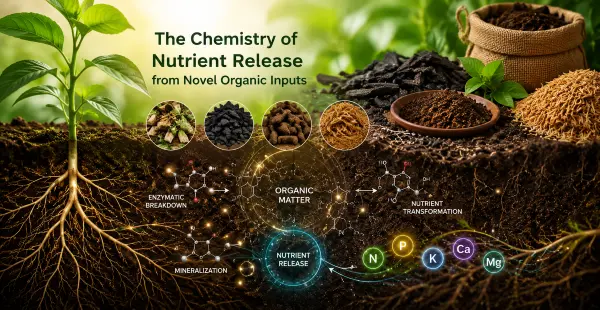
2. Deep Dive: Chemical Dynamics of Novel Inputs
Different novel inputs have completely unique biochemical fingerprints, meaning they behave differently once they hit the dirt.
A. Insect Frass (Excrement & Exuviae)
Insect frass (e.g., from Black Soldier Fly larvae) is taking the industry by storm.
- The Chemical Footprint: It features a narrow C:N ratio (usually around 10:1 to 15:1) and is rich in chitin—a polymer of N-acetylglucosamine.
- Release Dynamics: Because of the low C:N ratio, nitrogen mineralization happens rapidly, often within 1 to 3 weeks. Furthermore, the degradation of chitin triggers a spike in soil chitinase activity, which biochemically alters the soil microbiome to suppress fungal pathogens.
B. Microalgae and Seaweed Biostimulants
Algae-based inputs aren't just nutrient sources; they are massive chemical catalysts.
- The Chemical Footprint: Rich in anionic polysaccharides (like alginates and fucoidans) and polyols (like mannitol).
- Release Dynamics: Alginates possess a high density of negatively charged carboxylic acid groups. These groups act as natural chelating agents. They bind to polyvalent cations like iron ($Fe^{2+}$), zinc ($Zn^{2+}$), and calcium ($Ca^{2+}$), preventing them from precipitating out of the soil solution and keeping them highly available to plant roots.
C. Anaerobic Digestates
The liquid byproduct of biogas production is highly unique.
- The Chemical Footprint: During anaerobic digestion, organic nitrogen is already heavily converted into inorganic ammonium ($NH_4^+$), suspended in a high-pH liquid matrix.
- Release Dynamics: Because the nitrogen is already mineralized, it acts almost like a synthetic fertilizer for rapid uptake. However, because of its liquid nature and high pH, it is chemically vulnerable to volatilization (turning into ammonia gas, $NH_3$) if it is not immediately injected or incorporated into the soil.
3. Comparative Summary of Novel Inputs
| Input Type | Primary Chemical Form | Relative Release Speed | Key Chemical Mechanism |
| Insect Frass | Chitin & Amine-bound N | Fast to Medium | Rapid enzymatic cleavage via chitinases. |
| Microalgae | Polysaccharides & Amino acids | Medium | Chelation of micronutrients via carboxylic functional groups. |
| Anaerobic Digestate | Dissolved Ammonium ($NH_4^+$) | Immediate | Direct ionic availability; high risk of volatilization if unmanaged. |
| Biochar-Coated Blends | Sorbed organic complexes | Slow (Controlled) | High surface charge increases Cation Exchange Capacity (CEC), releasing nutrients slowly. |
4. Environmental Drivers of the Chemical Release
You can engineer the perfect organic input, but the soil environment always gets the final say. Three critical factors dictate the kinetics of nutrient release:
- Soil pH: The enzymes responsible for breaking down novel inputs have strict optimal pH ranges. For instance, acid phosphatases thrive in soils with a pH below 6.0, while alkaline phosphatases require a pH above 7.0. If the soil pH is misaligned, the chemical release stalls.
- Temperature and Moisture: Mineralization is a bio-chemical reaction. For every 10°C increase in temperature (up to roughly 35°C), the rate of chemical reactions and microbial metabolism roughly doubles ($Q_{10}$ temperature coefficient). Dry soils stop chemical diffusion, while waterlogged soils shift the chemistry to anaerobic pathways, causing denitrification and nutrient loss.
- Soil Texture and Mineralogy: Clays with high surface areas (like smectite) can chemically adsorb organic molecules onto their surfaces, shielding them from microbial enzymes and slowing down nutrient release compared to sandy soils.
💡 Pro-Tip for Agronomists
When utilizing novel inputs like insect frass or digestates, do not rely on standard mineralization models built for cattle manure. The highly labile carbon and pre-mineralized fractions in these new inputs require tight application windows—ideally just prior to peak crop demand—to prevent leaching and gaseous loss.
Conclusion: The Era of "Smart" Organic Nutrition
The chemistry of novel organic inputs proves that organic farming is no longer just a game of "dump and hope." By understanding the macromolecular structure of inputs like insect frass or algae, we can predict nutrient availability with unprecedented accuracy.
As we refine these inputs—coagulating them with biochar, optimizing their particle sizes, and blending them for specific soil types—we bridge the gap between sustainability and high-yielding precision agriculture.

The Chemistry of Nutrient Release from Novel Organic Inputs