Introduction
If you’ve ever stood in the gardening aisle, you’ve probably noticed two bags sitting side-by-side: one labeled "Potting Soil" and the other "Soilless Potting Mix." They look almost identical through the plastic packaging, but beneath the surface, they are entirely different beasts.
Choosing between them isn't about finding the "perfect" dirt—it’s about understanding what your specific plants need to breathe, drink, and grow. Let’s break down the real differences so you never have to guess at the garden center again.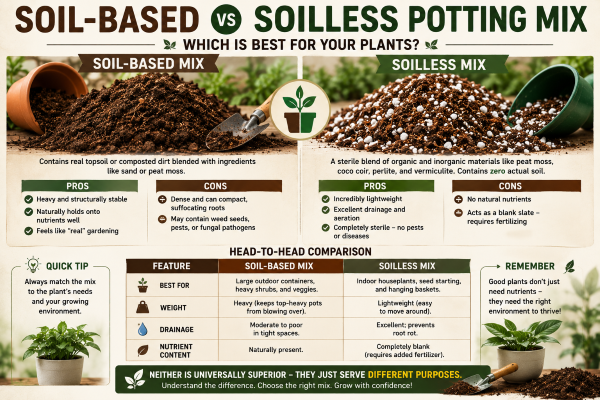
What is a Soil-Based Mix?
Soil-based potting mixes actually contain real topsoil or composted dirt, usually blended with ingredients like sand or peat moss to keep it from turning into brick.
- The Pros: It’s heavy, structurally stable, and naturally holds onto nutrients well. It feels like "real" gardening because, well, it is.
- The Cons: True soil is dense. In a confined container, it easily compacts, suffocating delicate plant roots. It also carries a risk of harboring hitchhiking weed seeds, pests, or fungal pathogens from the outdoor world.
What is a Soilless Mix?
Despite looking like dirt, a soilless mix contains absolutely zero actual soil. Instead, it’s a sterile blend of organic and inorganic materials like peat moss, coco coir, perlite (those little white volcanic glass pops), and vermiculite.
- The Pros: It is incredibly lightweight, offers unparalleled drainage, and is completely sterile (meaning no surprise pests or diseases).
- The Cons: Because it lacks real soil, it has virtually no natural nutrients. It acts as a blank slate, meaning you are entirely responsible for feeding your plants via fertilizers.
Head-to-Head: Which Should You Choose?
| Feature | Soil-Based Mix | Soilless Mix |
| Best For | Large outdoor containers, heavy shrubs, and veggies. | Indoor houseplants, seed starting, and hanging baskets. |
| Weight | Heavy (keeps top-heavy pots from blowing over). | Lightweight (easy to move around). |
| Drainage | Moderate to poor in tight spaces. | Excellent; prevents root rot. |
| Nutrient Content | Naturally present. | Completely blank (requires added fertilizer). |
Conclusion
Neither mix is universally superior, but they serve entirely different purposes. If you are growing heavy outdoor shrubs or vegetables that need a sturdy, nutrient-dense anchor, go with a soil-based mix. If you are planting indoor houseplants, succulents, or starting seeds from scratch, a soilless mix is the undisputed champion because it protects delicate roots from rot and pests.

Soil-Based vs. Soilless Potting Mix: Which Is Better?