For more than a century, global agriculture has relied on a single, massive chemical triumph: the Haber-Bosch process. By pulling nitrogen out of thin air using extreme heat and pressure, synthetic fertilizers effectively doubled the human carrying capacity of the planet.
But this industrial miracle came with a heavy price tag. Synthetic fertilizers consume roughly 1–2% of the world’s total energy, account for massive greenhouse gas emissions, and leave behind disrupted soil microbiomes and aquatic "dead zones."
As the agricultural sector targets net-zero emissions and regenerative practices, a critical question emerges: How will future farms feed their crops when the synthetic taps are turned off?
The answer doesn't lie in going backward to primitive farming; it lies in moving forward into a high-tech, bio-circular revolution. Here is how the future of crop nutrition is unfolding.
1. The Biological Revolution: Programming Living Nitrogen Factories
Instead of manufacturing nitrogen in a factory and shipping it across the globe, future farms will outsource the job directly to the soil microbiome.
While legumes (like soybeans and clover) have always fixed their own nitrogen via symbiotic relationships with Rhizobium bacteria, major cereal crops like corn, wheat, and rice cannot. Future farms are solving this using two primary biological innovations:
- Engineered Microbes: Agricultural biotech companies are successfully developing non-pathogenic, free-living diazotrophs (nitrogen-fixing bacteria). These microbes are applied as seed treatments. Once in the soil, they sense the plant's presence, colonize its roots, and continuously convert atmospheric nitrogen into plant-available ammonium right at the rhizosphere.
- Endophytic Inoculants: Researchers are isolating unique fungi and bacteria that actually live inside plant tissues. These endophytes protect the plant from stress while sharing fixed nutrients directly inside the host cell matrix, completely bypassing soil runoff vulnerabilities.
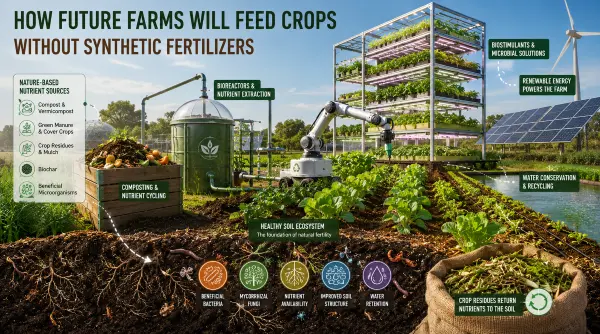
2. Upcycling the Anthropocene: The Circular Nutrient Economy
Plants need more than just nitrogen; they require a steady supply of phosphorus and potassium. Rather than mining finite rock phosphate reserves, future farms will exploit the vast, untapped reservoirs of urban and agricultural waste.
The Rise of Struvite
Wastewater treatment plants are transitioning into mineral mines. Through controlled chemical precipitation, they are recovering phosphorus and magnesium from sewage to produce struvite ($MgNH_4PO_4 \cdot 6H_2O$). Struvite is a crystalline, slow-release fertilizer that is highly efficient and virtually free of heavy metal contaminants.
Valorizing Food and Insect Waste
Instead of rotting in landfills, municipal food waste is being rerouted to intensive bio-conversion facilities. Utilizing Black Soldier Fly Larvae (BSFL), these facilities convert tons of organic waste into high-grade insect protein (for animal feed) and insect frass (excrement). This frass is a highly stable, nutrient-dense organic input packed with chitin, which naturally stimulates plant immune responses.
3. Smart Carbon Matrices and Nano-Delivery Systems
Raw organic materials like compost are wonderfully sustainable, but they are bulky, unpredictable, and slow to release nutrients. Future farms will use advanced material science to fix this efficiency gap.
💡 The Innovation: Biochar-Coated Bio-Blends
By infusing highly porous biochar (pyrolyzed biomass) with liquid organic digestates or microalgae extracts, scientists are creating "smart" fertilizer pellets.
The immense surface area and negative surface charge of the biochar act as a molecular sponge. It binds organic nutrients tightly, preventing them from leaching away during heavy rains. When the plant root grows near the pellet, root exudates (organic acids) trigger the biochar matrix to gradually unlock and release its nutrient payload exactly when the crop demands it.
4. How They Compare: Industrial vs. Future Nutrition
| Feature | Century-Old Synthetic Model | Future Bio-Circular Model |
| Primary Source | Fossil fuels (Natural gas) & Rock mining | Atmospheric fixation & Waste upcycling |
| Release Mechanism | Rapid water dissolution (High flush) | Microbially mediated or root-triggered |
| Soil Ecosystem Impact | Tends to degrade microbial diversity over time | Actively builds soil organic matter and biome health |
| Runoff & Leaching Risk | High (Leads to eutrophication) | Extremely low (Nutrients are bound to biology or carbon) |
| Carbon Footprint | Massive net-positive emissions | Net-negative or neutral carbon footprint |
5. Rhizosphere Whispering: AI and Plant-Driven Fertility
The ultimate iteration of the future farm doesn't involve blindly dumping organic nutrients onto a field. It relies on precision real-time communication.
Plants continuously secrete a cocktail of sugars, enzymes, and organic acids from their roots—known as root exudates—to signal what nutrients they need. For example, a phosphorus-starved plant will exude specific organic acids to mobilize locked-up soil minerals.
Future farms will deploy in-field optical sensors and microfluidic soil chips powered by machine learning. These sensors read the chemical composition of the rhizosphere's exudates. When the AI detects a chemical "cry for help" from the crop, targeted micro-doses of highly specific biological or organic liquids are delivered through sub-surface drip irrigation lines directly to that specific root zone.
Conclusion: The Ultimate Shift in Agronomy
Feeding crops without synthetic fertilizers is not a romantic return to historical farming methods; it is an evolution into a sophisticated bio-tech ecosystem. By combining the power of gene-selected soil microbes, structural waste recovery, and smart carbon matrices, future farms will achieve identical—or superior—yields to industrial agriculture.
The paradigm is shifting dramatically: we are moving away from chemical manipulation and entering the era of ecological mastery.

How Future Farms Will Feed Crops Without Synthetic Fertilizers