Introduction: The Urban Waste-to-Fertilizer Paradigm
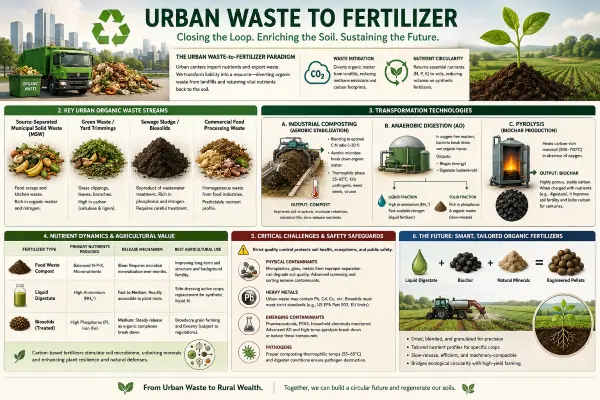
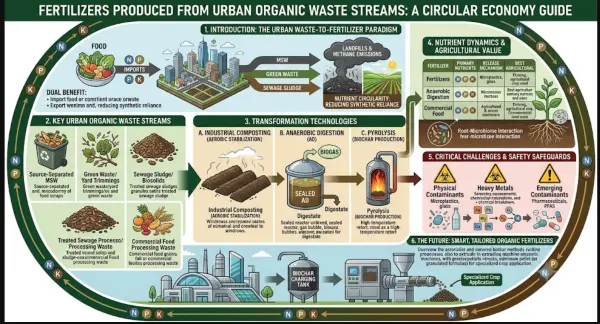
Urban centers are massive importers of nutrients (in the form of food, energy, and goods) and major exporters of waste. Traditionally, this waste ends up in landfills, producing methane—a potent greenhouse gas—or is incinerated, wasting valuable macro- and micronutrients.
Recycling urban organic waste streams into fertilizers offers a dual benefit:
- Waste Mitigation: Diverts tons of organic matter from landfills, slashing municipal carbon footprints.
- Nutrient Circularity: Returns vital elements like Nitrogen ($N$), Phosphorus ($P$), and Potassium ($K$) back to agricultural soils, reducing our reliance on energy-intensive synthetic fertilizers.
2. Key Urban Organic Waste Streams
Urban environments generate distinct organic waste streams, each with its own chemical profile and processing requirements:
- Source-Separated Municipal Solid Waste (MSW): Food scraps and biodegradable kitchen waste from households and commercial kitchens. It is highly rich in organic matter and nitrogen but prone to rapid decomposition and odor.
- Green Waste / Yard Trimmings: Grass clippings, leaves, and tree branches from public parks and residential landscaping. High in carbon (cellulose and lignin), making it an excellent structural matrix for composting.
- Sewage Sludge / Biosolids: The organic byproduct of municipal wastewater treatment plants. It is exceptionally rich in phosphorus and nitrogen but requires stringent treatment to eliminate pathogens, heavy metals, and synthetic contaminants.
- Commercial Food Processing Waste: Homogeneous waste from urban food manufacturing facilities, breweries, and markets. It features a predictable nutrient profile, making it easier to process than mixed residential waste.
3. Transformation Technologies
Converting raw urban waste into stable, crop-safe fertilizer requires specific biological, thermal, or chemical transformation technologies.
A. Industrial Composting (Aerobic Stabilization)
Aerobic composting utilizes oxygen-breathing microorganisms to break down complex organic matter into a stable, dark substance called humus.
- The Process: Waste is blended to achieve an optimal Carbon-to-Nitrogen ($C:N$) ratio (ideally around $30:1$). The mixture is piled in windrows or aerated static piles.
- Thermophilic Phase: Microbial activity naturally drives temperatures up to $55\text{°C}–65\text{°C}$. This high heat is critical because it neutralizes human pathogens, weed seeds, and plant viruses.
- The Output: Compost, which functions primarily as a stellar soil amendment, improving soil structure, moisture retention, and microbial diversity while delivering a modest, slow-release nutrient profile.
B. Anaerobic Digestion (AD)
Anaerobic digestion occurs in sealed, oxygen-free reactors where specialized bacteria break down highly wet organic inputs (like food waste and sewage sludge).
- The Process: The digestion process produces two primary outputs: biogas (methane and carbon dioxide) used for green energy, and a nutrient-rich liquid/semi-solid residue called digestate.
- The Output: Digestate can be separated into a liquid fraction (highly concentrated in readily available ammonium nitrogen, acting much like a liquid quick-release fertilizer) and a solid fraction (rich in phosphorus and slow-release organic matter).
C. Pyrolysis (Biochar Production)
Pyrolysis is the thermal degradation of carbon-rich urban wastes (like clean wood waste or dried biosolids) at high temperatures ($300\text{°C}–700\text{°C}$) in the total absence of oxygen.
- The Output: Instead of burning to ash, the material morphs into Biochar—a highly porous, stable carbon form. When "charged" or blended with nutrient-rich liquids like digestate, biochar acts as a permanent sponge in the soil, preventing nutrient leaching and fixing carbon for centuries.
4. Nutrient Dynamics & Agricultural Value
Urban waste-derived fertilizers behave differently in the soil compared to synthetic options. Understanding these chemical dynamics ensures effective crop nutrition:
| Fertilizer Type | Primary Nutrients Provided | Release Mechanism | Best Agricultural Use |
| Food Waste Compost | Balanced $N$-$P$-$K$, Micronutrients | Slow: Requires microbial mineralization over months. | Improving long-term soil structure and background fertility. |
| Liquid Digestate | High Ammonium ($NH_4^+$) | Fast to Medium: Readily accessible to plant roots. | Side-dressing active crops; replacement for synthetic liquid $N$. |
| Biosolids (Treated) | High Phosphorus ($P$), Iron ($Fe$) | Medium: Steady release as organic complexes break down. | Broadacre grain farming and forestry (subject to regulations). |
Because these fertilizers are carbon-based, they stimulate the indigenous soil microbiome. Beneficial fungi and bacteria proliferate, unlocking locked-up soil minerals and enhancing the plant's natural defense mechanisms.
5. Critical Challenges & Safety Safeguards
While the potential is massive, utilizing urban waste requires strict quality control to prevent environmental contamination and protect public health.
⚠️ Key Risk Factors in Urban Streams
- Physical Contaminants: Microplastics, glass shards, and metals from improper source separation can ruin soil quality. Depolymerization and screening tech are required at processing plants to filter these out.
- Heavy Metals: Urban wastewater and runoff can introduce Lead ($Pb$), Cadmium ($Cd$), and Copper ($Cu$). Biosolids must meet strict regulatory thresholds (such as the US EPA's Part 503 rules or EU standards) before application.
- Emerging Contaminants: Traces of pharmaceuticals, household chemicals, and PFAS ("forever chemicals") are increasingly monitored. Advanced anaerobic digestion and high-temperature pyrolysis are highly effective at breaking down or isolating these complex chemical bonds.
6. The Future: Smart, Tailored Organic Fertilizers
The next frontier for urban waste fertilizers is moving away from bulk, unrefined applications and moving toward engineered organic-mineral fertilizers.
Modern facilities are now drying liquid digestate, blending it with biochar, and granulating it into precise, pelletized formulas tailored to specific crop requirements. By infusing organic bases with precise amounts of natural minerals, scientists are creating predictable, slow-release pellets compatible with standard agricultural machinery—bridging the gap between ecological circularity and high-yield commercial farming.

Fertilizers Produced from Urban Organic Waste Streams